What is included in commercial hood and canopy cleaning?
Understand what a normal service should cover, what may be extra, and what to confirm before booking.
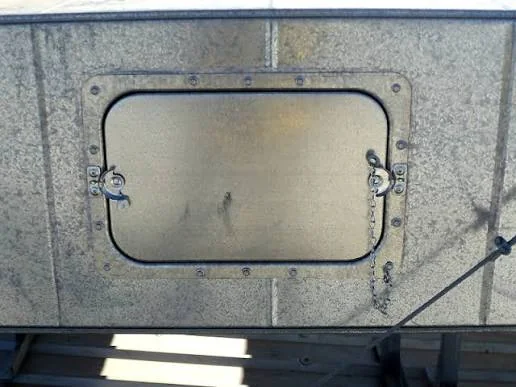
Commercial kitchen exhaust access panels are the doors, cover plates and openings that let a technician reach the inside of grease-bearing ductwork. Without them, a cleaning provider can only work on the sections that are accessible. A clean hood does not prove that the ductwork is clean, and a visual check from the kitchen cannot establish the condition of enclosed duct. Access panels are therefore a maintenance-planning issue, not just a detail for the installer.
In general, an access panel is a closure device used to cover an opening into a duct, an enclosure, equipment or an appurtenance. In practice, access panels may be hinged doors, bolted cover plates or other removable closures along the duct, at changes of direction, near the fan or at other service points.
Their size, location, material and fastening method depend on the system and the applicable design requirements. Not every duct run has the same access.
Grease-laden vapours move through the hood and into the exhaust duct. Grease can collect on duct walls, especially at changes of direction, horizontal runs and other surfaces. Cleaning requires reaching those surfaces with tools and, in some cases, seeing them. Inspection requires access too.
An access panel provides an opening for both. Without enough access, a provider may be limited to the hood, filters, fan and the duct sections that can be reached. The service record should say what was accessible and what was not.
Ductwork layout varies. A short, straight run with panels along it is easier to service than a long, concealed run with few openings. Access can be affected by ceilings, walls, roof equipment, insulation, fire-rated assemblies, stored goods, locked rooms and the height of the duct.
Some work may require ladders, lifts, roof access or confined-space procedures. These conditions affect the time, equipment and scope of a cleaning visit. They should be discussed before the appointment, not discovered on the day.
Access panels can become difficult to use. They may be painted shut, sealed with grease, blocked by equipment or storage, missing fasteners, damaged at the hinge or gasket, or no longer labelled. A panel that cannot be opened safely limits access. A missing or damaged panel can leave an opening that should be restored.
Panels should be put back in their normal condition after inspection or cleaning; the exact requirement depends on the applicable standard and jurisdiction. If a panel is damaged or missing, arrange an assessment rather than covering the opening with tape or a temporary patch.
A hood and canopy cleaning visit typically covers the components in the confirmed scope: hood and canopy surfaces, grease filters, accessible fan components and accessible exhaust areas. Duct interiors are included only when access is confirmed. The fan may be accessible from the roof or another service point.
Each part of the system can have a different condition. Cleaning the hood does not automatically clean the duct, and cleaning the duct does not automatically clean the fan. The scope should be specific.
A visual inspection of the hood can show grease on the canopy, filters and visible surfaces. It cannot show the inside of an enclosed duct. Grease can accumulate out of sight, and a duct can look fine from the kitchen while containing a significant deposit.
Access panels and a proper inspection are needed to establish duct condition. Even then, the inspection covers the areas that can be reached; it is not a certification of the entire system or a fire-safety approval.
Before booking a cleaning visit, ask:
Clear answers help both sides plan the work and avoid surprises.
A useful service record identifies the date, the components cleaned, the access points used, the areas that could not be reached and any visible observations. It may also note damaged panels, missing fasteners or other conditions that need follow-up. Ask whether photos are included if that matters to your records.
The record should be specific enough that a manager, landlord or authority having jurisdiction can understand what was and was not covered. It is not a compliance certificate unless the provider is qualified and engaged to issue one.
Repairs, alterations and new access openings are not cleaning tasks. They should be assessed by qualified personnel and completed in accordance with the applicable requirements, the system design and the manufacturer's instructions. Cutting into ductwork or installing a panel without the right assessment can affect the system, the building and safety.
If a panel is missing, damaged or inadequate, ask for the issue to be documented and arrange the appropriate trade. Grease Shields cleans accessible components within the confirmed scope and documents access limitations; work outside that scope should be referred.
Manufacturer cleaning instructions such as CaptiveAire's deep cleaning instructions describe access points used for duct cleaning and the need to restore access doors after work. The applicable edition and local requirements govern.
Review access at each service rather than assuming it will stay the same. Equipment gets moved, ceilings get modified, panels get painted or damaged, and storage can block a service point. Keep the service records together, note any access problems and address them before the next cleaning.
The right cleaning interval depends on cooking volume, cooking style, system condition and local requirements; your authority having jurisdiction sets any site-specific obligation. For general planning, read how often a commercial kitchen hood should be cleaned.
Only if the panel can be opened safely and the work is within the confirmed scope. Some panels are stuck, damaged or require a qualified trade. The provider should document the limitation rather than force the panel.
The requirement depends on the system, the applicable standard and the jurisdiction. Local codes address access in different ways. Your authority having jurisdiction and the system design are the reference.
No. The hood is only part of the exhaust system. Ductwork and the fan can accumulate grease out of sight. Access is needed to inspect and clean those areas.
If your restaurant is in St. John's or elsewhere on the Island of Newfoundland and you are planning hood or exhaust cleaning, Grease Shields can confirm the accessible scope for your system and document any limitations. See the hood and canopy cleaning service, the maintenance support, or request a quote. For related component reading, see hood filters: cleaning or replacement and exhaust fan belt maintenance.